I love literature, but another thing I love just as much is history.
Even better is when the two come together.
For me, nothing combines literature and history more powerfully than war poetry.
War has always brought out the very best and the very worst of humanity. It creates courage and sacrifice, but also unimaginable suffering and destruction. Throughout history, people have turned to poetry to make sense of experiences that seem impossible to put into words. In that way, poetry gives us one of the clearest windows into human nature.
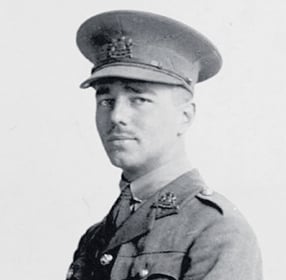
Among all the poets of the First World War, my favourite has always been Wilfred Owen.
In my opinion, nobody captured the reality of war quite like he did.
I first studied Owen's poetry in school, reading Exposure and Dulce et Decorum Est, and those poems have never left me. His writing doesn't feel like someone imagining war—it feels like someone who lived it, breathed it and carried it with him long after leaving the trenches.
Of course, that's because he did.
Owen was one of the approximately 70 million people who served during the First World War, and his poetry reflects experiences that many soldiers could never put into words themselves.
One reason I connect with his work more than that of poets like Rupert Brooke or Jessie Pope is that Owen experienced the trenches first-hand.
Brooke died before reaching the Western Front, while Pope wrote patriotic poems encouraging men to enlist. Her poem Play the Game, for example, compares war to football:
"Get to work with a gun.
When our country's at war, we must all back up—
It's the only thing to be done!"
Reading that alongside Owen's work couldn't feel more different.
Owen challenged the patriotic idea that dying for your country was glorious. His famous closing line in Dulce et Decorum Est describes the old Latin saying Dulce et decorum est pro patria mori as:
"The old Lie."
"It is sweet and fitting to die for one's country."
For Owen, war wasn't a game or an adventure.
It was suffering.
It was fear.
It was young people paying the price for decisions made far away from the battlefield.
One of my favourite quotations about the First World War comes from William Hussey's brilliant novel The Boy I Love:
"Now it's lives that are staked at this table, the bets of old men paid for in young blood."
I think that captures Owen's poetry perfectly.
As I'm currently studying the First World War in History, it seemed like the perfect time to write about one of my favourite poets.
Early Life
Wilfred Edward Salter Owen was born on 18 March 1893 in Oswestry, Shropshire.
He was the eldest of four children born to Thomas Owen, a railway clerk, and Susan Owen.
After the death of his grandfather in 1897, the family moved to Birkenhead before later settling in Shrewsbury, where Owen attended Shrewsbury Technical School.
Although he later matriculated at the University of London, he was unable to continue his studies because he couldn't afford the necessary scholarship.
Instead, he worked as an assistant to an Anglican vicar near Reading, caring for people in the local parish.
Many historians believe these experiences deepened his compassion for others, something that would become one of the defining characteristics of his poetry.
France
After recovering from illness, Owen moved to France in 1913.
He worked as an English teacher in Bordeaux and continued writing poetry.
His early poems were heavily influenced by Romantic writers such as John Keats and showed his growing love for language and poetic form.
Although he hoped to publish them as a collection, the book was never released.
The First World War
Owen enlisted in the British Army in 1915 and arrived in France early the following year as an officer in the Manchester Regiment.
Nothing could have prepared him for what he experienced.
He endured freezing conditions, bombardments, gas attacks and long periods living in flooded trenches. On one occasion, he spent days trapped near the body of a fellow officer.
The psychological effects were devastating.
In 1917, after a series of traumatic experiences, Owen was diagnosed with shell shock and sent to Craiglockhart War Hospital in Scotland.
Ironically, this would become one of the most important moments of his literary career.
Craiglockhart
While recovering, Owen met one of his literary heroes, Siegfried Sassoon.
Sassoon encouraged him to stop writing idealised poetry and instead tell the truth about what he had witnessed.
His doctor, Arthur Brock, also encouraged creative writing as part of Owen's recovery and introduced him to The Hydra, the hospital magazine.
Together, these influences transformed Owen into the poet we remember today.
Almost all of his greatest works were written after this point.
Returning to the Front
Despite everything he had experienced, Owen chose to return to active service in 1918.
He led his men with remarkable courage during the crossing of the Sambre-Oise Canal and the breaking of the Hindenburg Line.
For his bravery and leadership, he was awarded the Military Cross.
Tragically, he would never receive the medal himself.
On 4 November 1918, Wilfred Owen was killed while leading his platoon.
He was just 25 years old.
Exactly one week later, on 11 November 1918, the Armistice brought the First World War to an end.
Perhaps the cruellest part of Owen's story is that his mother received the telegram informing her of his death just as church bells across Britain were ringing to celebrate peace.
His Legacy
Remarkably, almost all of the poems for which Owen is famous were written in little more than a year, between August 1917 and September 1918.
His goal was never to glorify war.
Instead, as he wrote in the preface to his planned collection:
"My subject is War, and the pity of War. The Poetry is in the pity."
Those words perfectly sum up everything he hoped to achieve.
My Favourite Poems
If I had to choose just three, they would be:
- Exposure
- Dulce et Decorum Est
- Anthem for Doomed Youth
Exposure perfectly captures the slow, relentless misery of trench warfare. One of the lines that has always stayed with me is:
"We turn back to our dying."
It reminds us that soldiers didn't only fear bullets.
Cold, exhaustion, disease and endless waiting could be just as deadly.
Dulce et Decorum Est was the first Owen poem I ever read, and it completely changed the way I thought about war.
Before reading it, most of what I'd encountered was either history textbooks or patriotic accounts.
Owen showed something very different.
He showed the reality.
Finally, Anthem for Doomed Youth explores the cost of war for ordinary young soldiers—the people who actually fight the battles while others make the decisions.
Its opening line, describing those who "die as cattle," has stayed with me ever since I first read it.
I could honestly talk about these poems for hours—but I'll save that for another article!
If you'd like to read them yourself, I'd highly recommend all three.
Final Thoughts
I hope you've enjoyed reading this feature as much as I enjoyed researching and writing it.
Wilfred Owen's poetry continues to matter because it reminds us of the human cost of war.
More than a century later, conflict still exists across the world, and too often it is ordinary people who pay the highest price.
Perhaps that's why Owen's work still feels so powerful today.
His poetry doesn't ask us to celebrate war.
It asks us to remember those who endured it.
And I think that's a message worth reading, no matter the century.