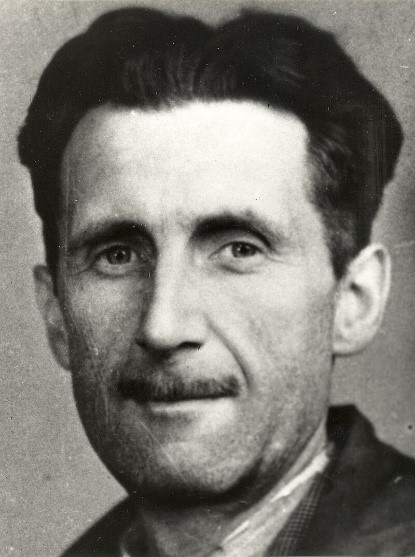
The Life of George Orwell
Eric Arthur Blair. Or, better known by his pen name, George Orwell.
One of history's most famous authors, and one of my personal favourites.
His brilliant political works, such as Animal Farm, have echoed through both literary history and politics, continuing to strike a chord with readers around the world.
I was introduced to Animal Farm in Year 8 and immediately fell in love with Orwell's writing. The allegory fascinated me, and the links to real-world politics made it even better. Everything—from the unforgettable characters to the way he wrote—made me want to keep reading. I also have to thank my English teacher for making studying it genuinely interesting rather than turning it into another boring school book.
But it's not just Animal Farm and Orwell's political fiction that I love. His autobiographical works, such as Homage to Catalonia and Down and Out in Paris and London, are equally brilliant.
In Down and Out in Paris and London, Orwell explores poverty through his own experiences. I found it incredibly thought-provoking and think it's a book everyone should read. If you're like me, you're fortunate to have the things you do—but not everyone is. Poverty remains a huge issue today, and many of the struggles Orwell described almost a century ago still exist. Reading the book opens your eyes to the lives of others, and I genuinely think the world would be a little kinder if more people read it.
Homage to Catalonia tells the story of Orwell's time fighting in the Spanish Civil War. He witnessed a world-changing conflict first-hand and writes about it so vividly. As a huge history nerd (especially when it comes to Spanish history), I absolutely loved it. I first learned about the conflict from my Spanish teacher, who also happens to be a huge Orwell fan, and I can't thank him enough for recommending the book.
Anyway, I'm aware I've rambled quite a bit already—but I really do love Orwell's work.
This month is dedicated to Orwell because he was born on 25 June 1903. I hope this feature encourages more people to discover just how brilliant his writing is.
So, without further ado, here's The Life of George Orwell.
Early Life
Eric Arthur Blair was born on 25 June 1903 in Motihari, Bengal, to Richard Walmsley Blair and Ida Mabel Blair. His father worked as an Opium Agent for the Indian Civil Service.
The family soon returned to England, where Orwell was largely brought up by his mother. The landscapes of the Thames Valley would later inspire the setting of his novel Coming Up for Air (1939).
School Years
Orwell was a studious child. He attended St Cyprian's Preparatory School before winning a King's Scholarship to Eton College in 1917.
By his own admission, he wasn't the hardest-working student at Eton. Later in life, he wrote, "No one can look back on his school days and say they were altogether happy." He left Eton in December 1921 after completing only one term in the sixth form.
The following year, he sat the entrance examination for the Indian Imperial Police and was accepted into the Burma division.
Burma
Although many people see Orwell's years in Burma as lonely and difficult, his family had long-standing connections with Britain's Eastern Empire, which partly explains why he chose to work there.
While relatively little is known about his day-to-day life, the experience inspired several of his earliest and best-known works, including A Hanging, Shooting an Elephant, and his first novel, Burmese Days (1934).
After five years, Burma had taken a heavy toll on his health, and his views on imperialism had changed dramatically. He returned to England in 1927 on medical leave before resigning from the Burmese Police.
Becoming a Writer
For the next five years, Orwell lived as an impoverished writer. He spent time in his parents' home in Suffolk, worked in private schools, lived in Paris and even disguised himself as a tramp to experience life at society's margins.
These experiences became the basis for his first published book, Down and Out in Paris and London (1933).
It was during this period that Eric Blair adopted the pen name George Orwell, combining the name of King George with the River Orwell in Suffolk.
Sadly, pneumonia ended his teaching career in 1934. During his recovery, he completed his second novel, A Clergyman's Daughter (1935).
He later worked in a London bookshop, where he found inspiration for Keep the Aspidistra Flying (1936). Around the same time, he married Eileen O'Shaughnessy.
Politics and Spain
The newly married couple settled in Wallington, Hertfordshire.
Around this time, Orwell travelled through the industrial North of England, gathering material for The Road to Wigan Pier (1937). The second half of the book explores his views on socialism, although his political beliefs were still developing.
Everything changed when he travelled to Spain.
In 1937, Orwell spent six months fighting as a Republican volunteer during the Spanish Civil War against Franco's Nationalist forces.
During the conflict, he was shot through the throat. The bullet narrowly missed his carotid artery, and many considered it miraculous that he survived. As Orwell later wrote in Homage to Catalonia:
"I could not stop thinking that it would be even luckier not to be hit at all."
He also witnessed the persecution of the POUM militia by Soviet-backed forces. These experiences transformed his political thinking.
Orwell later wrote that Spain made him "believe in Socialism for the first time" while also convincing him that totalitarianism, whatever its political colour, must always be opposed.
War Years
Homage to Catalonia was published in 1938 after Orwell returned to England.
Soon afterwards, he suffered a severe lung haemorrhage and spent nearly a year recovering in England and Morocco.
Although Orwell initially opposed the Second World War, the Nazi-Soviet Pact of 1939 changed his outlook. He came to believe that defeating fascism was essential and hoped the war would encourage a fairer society. These ideas appeared in his 1941 essay The Lion and the Unicorn.
Unable to join the armed forces because of his poor health, Orwell worked for the BBC's Eastern Service.
He disliked the job intensely, once describing the atmosphere as being "something between a girls' school and a lunatic asylum."
In 1943, he left to become Literary Editor of the Tribune, where he also wrote his famous column, As I Please.
Animal Farm
Orwell completed Animal Farm in 1944.
The novel is a brilliant political allegory inspired by the Russian Revolution and the rise of the Soviet Union. However, because Britain was allied with the Soviet Union during the Second World War, publishers were reluctant to release a book that criticised Stalin.
As a result, Animal Farm was not published until August 1945.
Sadly, this professional success came during one of the darkest periods of Orwell's life.
Just five months earlier, his wife Eileen had died unexpectedly following routine surgery. Shortly before her death, the couple had adopted a baby boy, Richard Horatio Blair, whom Orwell was now determined to raise with help from his sister, Avril.
The Final Years
With support from his friend David Astor, Orwell moved to the remote Scottish island of Jura.
Despite suffering from increasingly poor health, he spent much of his final years writing what would become his masterpiece: Nineteen Eighty-Four.
After completing the manuscript, he suffered a serious collapse caused by advanced tuberculosis.
The novel was published in 1949 and became an immediate success, but Orwell sadly had very little time to enjoy it.
He died at University College Hospital in London on 21 January 1950, aged just 46.
Shortly before his death, he married Sonia Brownell.
Orwell's Legacy
Orwell's death was a huge loss to literature.
He is remembered not only for his incredible writing but also for his willingness to challenge power and expose injustice. Through novels like Animal Farm and Nineteen Eighty-Four, he warned us about propaganda, censorship and totalitarianism.
The question is: did we listen?
How close are we to the dystopian world he imagined, where the clocks strike thirteen, and Big Brother is always watching? That's for each of us to decide.
Final Thoughts
I've absolutely loved writing this feature because George Orwell is one of my favourite figures in literature.
I really hope you've enjoyed reading it as much as I've enjoyed writing it.
So, what's your favourite Orwell book?
Mine is definitely Animal Farm—but I'll spare you another long rant about why!
Who's your Orwell?